- Stack
- Python · PyTorch · FastAPI · React
- Domain
- ML · C-UAS
- Status
- Complete · Jun 2026
- 86%
- Correct Target
Identified - 64s
- Avg Warning
Before Impact - 5
- Operating
Modes
Most C-UAS systems wait for the drone to commit before they act. By then, the intercept window is already closing. The problem isn't spotting the threat — it's that operators have no signal on intent until the terminal approach makes it obvious.
A drone physics simulator generates synthetic flight data encoding heading bias, speed deceleration, and operator commitment patterns. A PyTorch LSTM trains on this data to classify which specific target the drone is committed to, outputting a ranked probability across all candidates. The result reaches the operator in real time: a live threat queue with time-to-impact and intercept window, giving defenders a decision advantage before the drone's final approach begins.
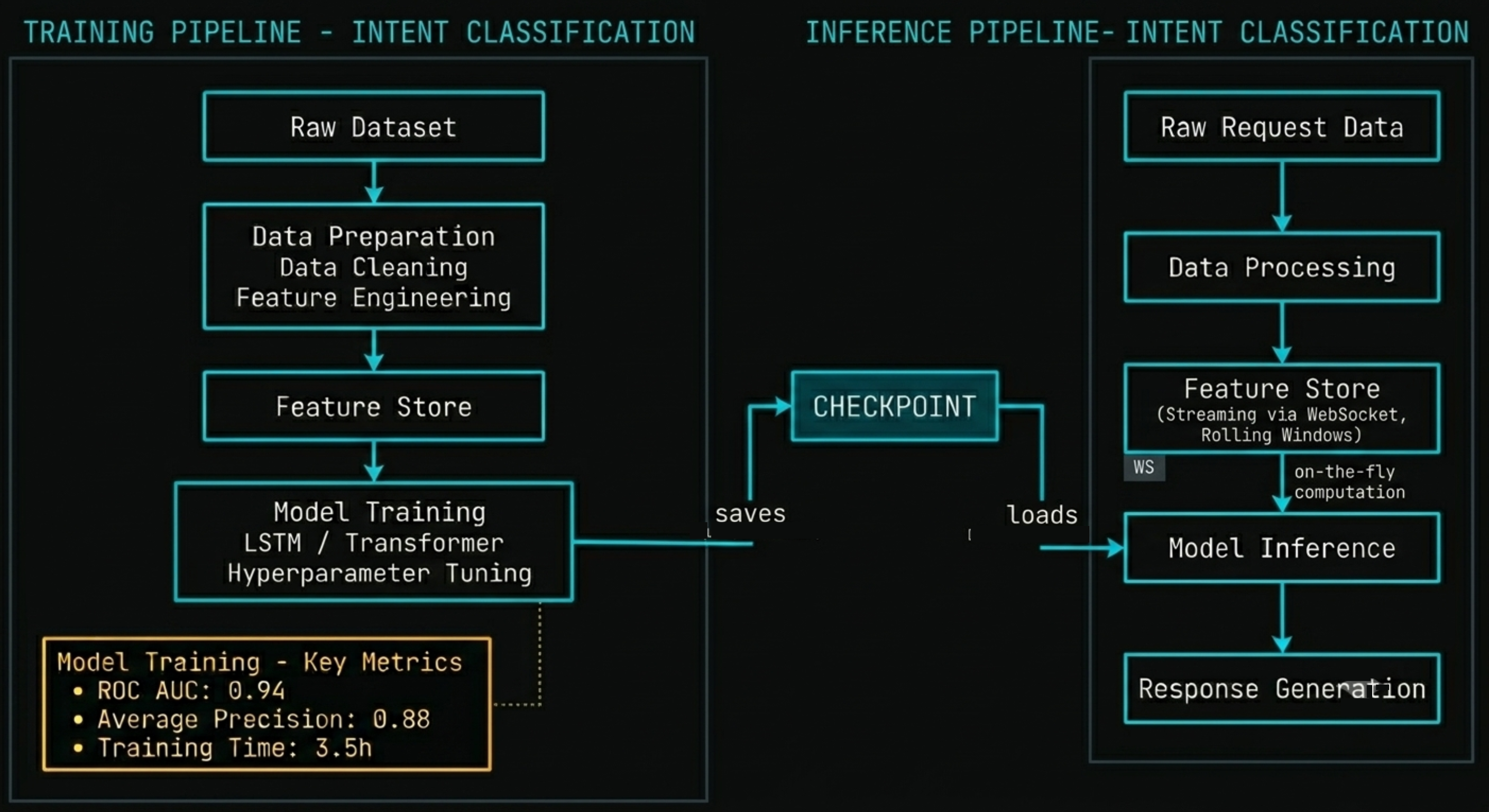
End-to-end ML pipeline from physics simulator through feature engineering to real-time inference — outputting a probability distribution over candidate targets on every tick.
React frontend streaming live threat queue, time-to-impact countdown, intercept window geometry, and saturation alerts for simultaneous multi-drone scenarios.
Configurable adversarial attack scenarios that let operators probe model blind spots and measure confusion periods before operational use.
Shifting from terminal geometry to flight dynamics buys up to 30 seconds of intercept window that didn't exist before. The full pipeline covers the simulator, feature engineering, model, and operator interface, proving that intent is readable well before the drone commits. Red Team mode exists because a system that's never been broken isn't one you can trust.